Über Liquid War — an army that follows your cursor
Liquid War — an army that follows your cursor ist ein kostenloses Strategie-Spiel, das direkt in deinem Browser läuft. Kein Download, kein Konto: einfach auf Spielen drücken und loslegen. Funktioniert auf PC, Laptop, Tablet und Handy.
Spielbeschreibung
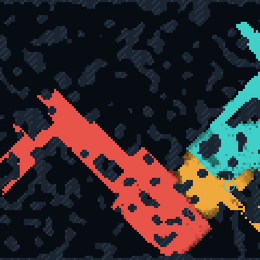
Your army is a few thousand fighters and you command none of them: you move one cursor, and every fighter of your colour floods through the maze along the shortest path to it. When two colours meet nobody dies — the loser changes sides, so the map is a tug of war over one fixed population and every fight you win makes you bigger. Feed a corridor one fighter at a time and you hand it over; pull back until the queue bunches up and arrive all at once, and you take it. Seeded battlefields in six shapes, up to four armies, five opposing temperaments and a twelve-battle ladder that bends one rule at a time.
So wird gespielt
Drücke auf Spielen, um das Spiel zu laden. Die meisten Spiele steuerst du mit der Maus oder per Touch; Tastaturspiele nutzen die Pfeiltasten, WASD oder die Leertaste. Die genaue Steuerung steht in der Anleitung im Spiel. Im Vollbild macht es am meisten Spaß.
Häufige Fragen
Ist Liquid War — an army that follows your cursor kostenlos?+
Ja. Liquid War — an army that follows your cursor ist komplett kostenlos und läuft im Browser. Du musst nichts herunterladen und kein Konto anlegen.
Kann ich Liquid War — an army that follows your cursor auf dem Handy spielen?+
Ja. Liquid War — an army that follows your cursor läuft in aktuellen mobilen Browsern auf iPhone, iPad und Android sowie auf Windows-, Mac-, Linux- und Chromebook-Computern.
Wird mein Fortschritt gespeichert?+
Punktestände und Fortschritt werden lokal im Browser auf diesem Gerät gespeichert. Wenn du die Browserdaten löschst, werden sie zurückgesetzt.
Wer hat Liquid War — an army that follows your cursor entwickelt?+
Liquid War — an army that follows your cursor ist ein Open-Source-Spiel von Tobias Müller (GPTGames), veröffentlicht unter der MIT-Lizenz.
Credits
Entwickelt von Tobias Müller (GPTGames). Open Source unter der MIT-Lizenz. Quellcode ↗