About Everywhere — write one rule that solves every maze
Everywhere — write one rule that solves every maze is a free online Puzzle game that runs right in your browser. There is nothing to download and no account to create: press Play and you are in. It works on desktop, laptop, tablet and mobile.
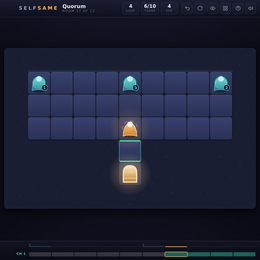
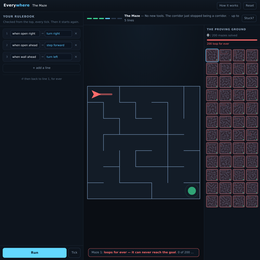
A programming puzzle where you never solve a level. You write one short rulebook for a robot — plain if-then lines, read top to bottom and then repeated — and the game tests it against hundreds of mazes you have never seen, then shows you the one that beats it, with your robot's path drawn on it. Eight stages take you from a straight corridor to the wall-following rule that solves every maze, then start taking the robot's senses away and make you rebuild it blind. Below them is The Deep, an endless run of handicaps drawn from an exhaustive table of which vocabularies can solve a maze at all — so every round is known to be beatable, and tells you in how many lines.
How to play
Press the Play button to load the game. Most games are played with the mouse or by tapping the screen; keyboard games use the arrow keys, WASD or the space bar. Read the in-game instructions for the exact controls, and use the fullscreen button for the best experience.
Frequently asked questions
Is Everywhere — write one rule that solves every maze free?+
Yes. Everywhere — write one rule that solves every maze is completely free to play in your browser. You do not need to download anything or create an account.
Can I play Everywhere — write one rule that solves every maze on my phone?+
Yes. Everywhere — write one rule that solves every maze works in modern mobile browsers on iPhone, iPad and Android phones, as well as on Windows, Mac, Linux and Chromebook computers.
Is my progress saved?+
Scores and progress are stored locally in your browser on this device. Clearing your browser data will reset them.
Who made Everywhere — write one rule that solves every maze?+
Everywhere — write one rule that solves every maze is an open-source game by Tobias Müller (GPTGames), published under the MIT license.
Credits
Created by Tobias Müller (GPTGames). Open source under the MIT license. Source code ↗